Members and shares
A DAO's members are the accounts that hold its voting shares. This page explains what shares are and who can vote with them, how to delegate, how transferable shares and the holding period work as settings, how shares are issued and burned, how a member is frozen and unfrozen, and why pools and other infrastructure should be excluded. It ends with a guide to the Members section of a DAO's page. How votes are counted on a proposal is in Proposals and voting.
Shares and voting power
Each DAO has its own share token, an ERC-20 with 18 decimals. Shares are voting power: one share, one vote, counted down to the smallest unit. A member is any account that holds voting shares.
- The founders receive the first shares when the DAO is created; see Create a DAO. The treasury may keep shares in reserve.
- Your voting power is your own shares plus any shares other members delegated to you.
- Some shares never vote and never count towards quorum: shares held by the treasury, by frozen members, and by accounts the DAO excluded as infrastructure.
- Each proposal reads voting power at the block before it was submitted, and, with a holding period, a second time earlier; see Snapshots and The holding period.
COLLAB has no built-in exit: a member who leaves does not take a part of the treasury. Where transfers are allowed, members can pass their shares on, and any payment from the treasury needs a proposal.
Delegation
You vote with your own shares by default; there is nothing to activate. You can delegate them to another member, who then votes with your shares as well as their own on every proposal. Your own vote on a proposal always replaces your delegate's vote for your shares, before or after they vote, as on GenesisL1. How that is counted is in Delegation.
To delegate:
- Open the DAO's Members section and press Delegate my vote, or press Delegate in the row of the member you choose, or Delegate under Your membership on any page of the DAO.
- In Delegate your voting power, enter the Delegate address and press Delegate. Your wallet sends one transaction.
- To take your votes back, press Vote with my own shares in your own row of the table.
You cannot delegate to the treasury or to a frozen member, and a frozen member cannot delegate. A new delegation counts from the next proposal on: proposals already open keep the delegation that existed when they were submitted.
Transferable shares and the holding period
The founders choose whether members may transfer shares to each other. When transfers are off, shares move only to and from the treasury: members can still return shares to the treasury, and the DAO issues and distributes them by proposal.
A Governance rules proposal changes this with its Share transferability action: Transferable between members or Only to and from the treasury. Governance rules proposals always use the critical rules.
- Transferable shares need a holding period, so a position bought just before a proposal cannot decide it. The share token refuses to turn transfers on while there is none, so when the DAO has no holding period the proposal sets one first, in the same batch (Holding period to set first).
- Anyone who receives transferable shares becomes a voting member, so voting power can be bought and sold. The holding period keeps freshly bought shares from deciding a vote.
- Once shares have been transferable, the share token remembers it for good, even if transfers are switched off again. Equal per-member airdrops then end for good, because a holder could have split shares across many accounts; pro rata airdrops keep working. See Member airdrops.
The holding period is a number of blocks. With a holding period of N blocks, a proposal counts the lower of an account's voting power at its snapshot and N blocks earlier, so shares or delegations received within that window carry no weight on it. As a setting:
- A DAO created with transferable shares starts with 7,200 blocks, about 28 hours at GenesisL1's average of 14 seconds per block. A DAO whose shares cannot be transferred starts without one.
- The Holding period action of a Governance rules proposal sets it from 0 to 2,250,000 blocks, about a year. 0 turns it off, which is possible only while shares are not transferable.
- A new value applies to proposals submitted after the change executes; open proposals keep their snapshots.
- When shares are not transferable, a holding period mainly delays the voting power of newly issued or distributed shares.
The DAO's Settings section shows the current value under Shares and holding period.
Issuing and burning shares
New members join when a Membership proposal gives them shares. Membership proposals always use the critical rules. Three of their actions concern shares:
| Action | What it does |
|---|---|
| Issue new shares | Creates new shares for one or more accounts. New shares carry voting power (after the holding period, where the DAO has one) and dilute every existing member. Shares issued to the treasury do not vote until the DAO distributes them. |
| Distribute treasury shares | Sends shares the treasury already holds to members. Treasury shares do not vote; once distributed they do, and they dilute every existing member. |
| Burn treasury shares | Destroys shares the treasury holds. Members' shares cannot be burned. |
The composer shows the total supply and the treasury's shares before and after, and a figure of voting power now and after, with the new holders hatched. A frozen account cannot receive shares. If you hold no shares, Propose shares for me in the Members section opens an Issue new shares proposal with your address filled in. Submitting it takes the voting power the DAO's rules ask of a proposer; see Every parameter and its range.
Freezing and unfreezing members
A Membership proposal can freeze a member with Freeze a member and restore them with Unfreeze a member. Both always use the critical rules.
Once a freeze executes:
- the member's shares stay in their account, but they cannot vote, move, delegate or receive shares, propose, or claim member airdrops;
- their representative and key steward powers stop at once;
- their voting power leaves every future tally and quorum from the next block, and votes they already cast stay counted;
- proposals that were already open keep their snapshot: the frozen shares stay in that proposal's quorum base, and a delegate the member chose earlier can still vote with them there.
Once an unfreeze executes, voting power returns from the next block. Proposals submitted while the member was frozen keep their snapshot, so they vote again from the next proposal on, and with a holding period, once it has passed.
The treasury cannot be frozen, and neither can an account the DAO excluded as infrastructure: the composer refuses both, and the governor refuses a freeze proposal that names an excluded account at submission. One proposal can name up to 32 accounts, one freeze action each. A Raw transaction that freezes an account is not a freeze proposal: it always needs the critical rules, but it places no lock and carries no bond.
Freeze locks
Without protection, a member could move their shares away while a vote to freeze them runs. A DAO can switch on freeze locks ("Lock a member's shares while a vote to freeze them is open"), and every preset does.
- The accounts to freeze are recorded when the proposal is submitted, but nothing is locked until the deposit is reached and voting starts, so an unfunded proposal cannot lock anyone.
- The lock lasts until one second after the last moment the proposal can be executed: the end of voting, plus the timelock, plus the execution window.
- A locked member can still vote and delegate; only transfers are blocked. With transferable shares, a freeze vote therefore blocks a member's transfers for the whole vote, even one the member wins.
- Freeze votes about one account can run side by side. Each places its own claim on the account when its vote starts, also while the account is already frozen. The shares stay locked until every claim has been released or the latest end has passed, so one proposal ending cannot unlock an account another proposal is still voting on.
- A claim is released only by the proposal that placed it, once that proposal is over, whatever its outcome. Anyone can do it with Release provisional share locks on the proposal's page. Freezing or unfreezing the account leaves the claims alone.
Because freeze votes can overlap and follow each other, a series of freeze proposals can keep a member's shares locked for as long as it lasts, and anyone can fund one. Anyone can also complete a partly funded freeze proposal's deposit and so start its vote at a moment of their choosing. In a DAO with transferable shares, set a minimum deposit that makes such a series expensive; the composer warns when a proposal turns share transfers on. A DAO that does not want this trade-off can leave freeze locks off. A proposal keeps the settings it was submitted with, so a freeze proposal submitted before the DAO turned on the lock has none.
The freeze bond
With the freeze bond ("Forfeit the deposit of a freeze vote that fails"), on in every preset, a freeze proposal that is Rejected or ends with No quorum forfeits its deposits, to the treasury or the burn address as the DAO's penalties go. A failed attempt to freeze a member costs those who backed it.
- A vetoed freeze proposal follows the DAO's rule for vetoed proposals, and one whose deposit period ends follows its rule for proposals that never reach their minimum.
- A freeze that passes but cannot be executed keeps its lock until its window ends and gets its deposits back: the bond covers votes that fail, not execution.
- A freeze proposal submitted before the DAO turned on the bond carries none.
The general rules for deposits, refunds and penalties are in Deposits, refunds and penalties; the flags are explained in Penalties and protection flags.
Excluding infrastructure
Contracts that hold shares for others, such as a DeSciFi pool, an LP lock box or a multisig, would otherwise count as members: their shares would vote, count towards quorum and receive member airdrops. A Governance rules proposal's Excluded accounts action marks them as infrastructure (Exclude from membership) or reverses it (Count as a member again).
An excluded account:
- has no voting units and never counts towards quorum;
- is not a member, so it gets no member payouts or airdrops;
- cannot be frozen or locked by a freeze vote;
- keeps its shares, and can still move them where transfers are allowed.
Exclude pools and other infrastructure before trading starts. A share lock that a freeze vote placed before an account was excluded lasts until that proposal releases it, and halts a pool for that long. An exclusion must also have executed before an airdrop proposal is submitted to keep that account out of the airdrop.
Do not use an exclusion on a person. The composer warns when an account looks like a wallet rather than a contract: excluding it takes away its vote and its airdrops without freezing it. To suspend a person, freeze them.
The Members section
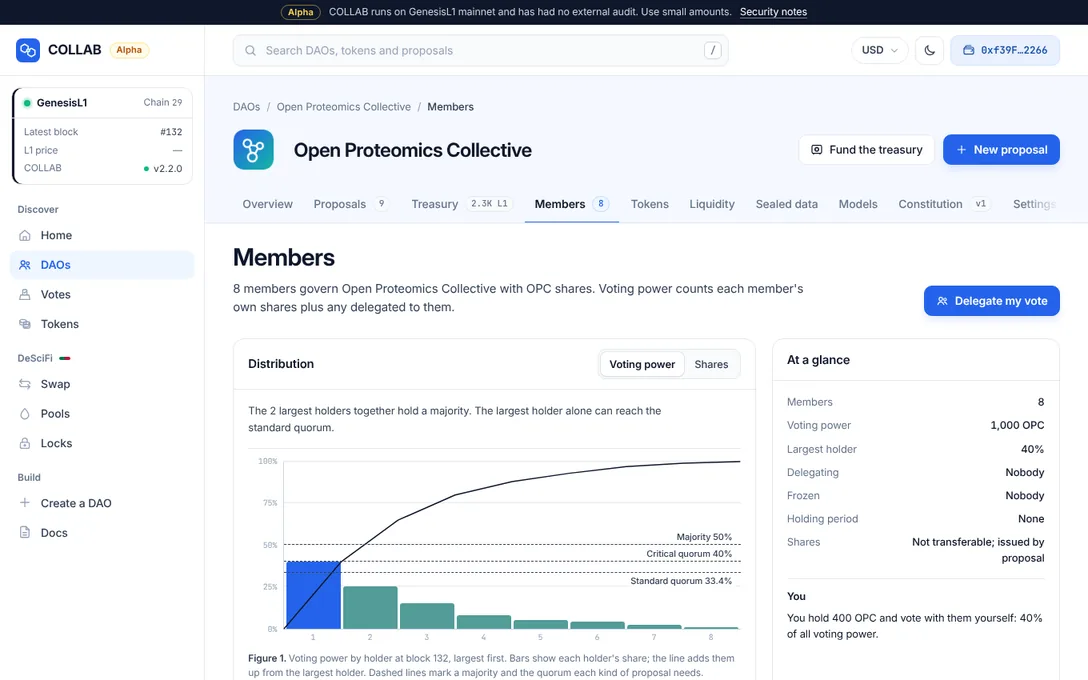
The Members section of a DAO is at /dao/<web address>/members. Its heading counts the members and offers Delegate my vote (or Change delegate) when your wallet holds shares, and Propose new members otherwise.
- The distribution figure shows voting power or shares by holder, largest first, with dashed lines for a majority and for the quorum each kind of proposal needs.
- At a glance lists Members, Voting power, Largest holder, Delegating, Frozen, Holding period and Shares (transferable or not), and under You, your own shares, delegation and any airdrop you can claim.
- Everyone who holds or held shares is the table of accounts. Filter it by All, Representatives, Key stewards, Frozen, Locked and Former, search by address, and sort by Shares, Voting power or Delegation. The Status column shows Frozen, Locked until a date, Lock ran out (the lock has expired but a claim is still recorded) and open freeze claims with links to their proposals. Each row offers what you can do: Delegate, Propose a freeze, Propose unfreezing or, for an infrastructure account that is not excluded, Propose excluding it.
- Infrastructure accounts lists the excluded accounts, with Propose including it. When the page finds a pool or lock box that holds shares without being excluded, a warning says that it counts as a member.
- How delegation works and Joining, leaving and freezing summarise the rules of this DAO, including whether it uses freeze locks.
Members are found from changes of voting units since the DAO was created; balances, delegations and roles are read live from the chain.