
Governance rules and presets
A DAO's governance rules decide how a proposal reaches a vote, what it takes to pass and when the result takes effect. This page lists every setting with the range the contracts enforce, the three presets of the creation wizard, the two rule sets (standard and critical), the deposit flags, and how a DAO changes its rules later. It is for founders choosing rules and for members who propose to change them. How one vote is counted is on Proposals and voting.
The presets
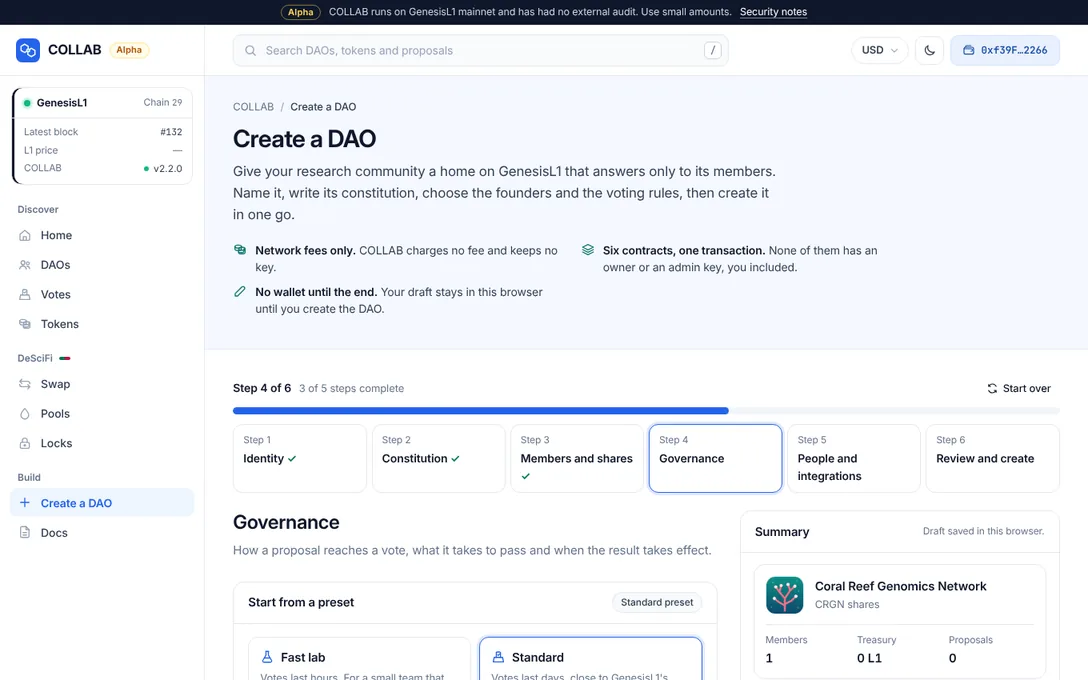
The Governance step of the creation wizard starts from a preset, Standard unless you choose another. A preset fills every field; changing any value makes the rules Custom rules. Members can change all of them later with a Governance rules proposal.
| Setting | Fast lab | Standard | Conservative |
|---|---|---|---|
| In the wizard's words | Votes last hours. For a small team that talks every day. | Votes last days, close to GenesisL1's own governance. | Votes last weeks. For a large treasury or a widely spread membership. |
| Minimum deposit | 1 L1 | 10 L1 | 50 L1 |
| Paid when submitting | 25% | 25% | 50% |
| Deposit period | 12 hours | 7 days | 14 days |
| Voting power needed to propose | 1 share | 1 share | 1 share |
| Execution window | 3 days | 14 days | 30 days |
| Standard voting period | 6 hours | 3 days | 14 days |
| Standard timelock | 1 hour | 1 day | 3 days |
| Standard quorum | 33.4% | 33.4% | 40% |
| Standard pass threshold | 50% | 50% | 50% |
| Standard minimum Yes | 10% | 10% | 15% |
| Standard veto threshold | 33.4% | 33.4% | 33.4% |
| Critical voting period | 1 day | 7 days | 21 days |
| Critical timelock | 6 hours | 2 days | 7 days |
| Critical quorum | 40% | 40% | 50% |
| Critical pass threshold | 66.67% | 66.67% | 75% |
| Critical minimum Yes | 20% | 20% | 25% |
| Critical veto threshold | 33.4% | 33.4% | 33.4% |
| Deposits forfeited when | vetoed | vetoed | vetoed, or quorum missed |
| Forfeited deposits go to | the treasury | the treasury | the treasury |
| Freeze lock and freeze bond | on | on | on |
| Also critical, besides the five | none | none | Treasury spend, Issue a token, Manage a token |
Every preset sets a minimum Yes, so a vote cannot pass on abstentions and a handful of Yes votes, and every preset turns on the freeze lock and the freeze bond. The wizard's In plain words card restates whatever you choose as sentences, and the review shows the standard and critical rules side by side.
Every parameter and its range
Percentages are stored in basis points, hundredths of a percent: 33.4% is 3,340. The contracts refuse any value outside these ranges, at creation and at every change.
Deposits and proposing, one set for the whole DAO:
| Setting | Label in the wizard | Range |
|---|---|---|
| Minimum deposit | Minimum deposit | 0 to 1,000,000 L1. Zero sends every proposal straight to a vote. |
| Initial deposit | Paid when submitting | 0% to 100% of the minimum deposit |
| Deposit period | Deposit period | 10 minutes to 365 days |
| Execution window | Execution window | 1 to 365 days |
| Proposal threshold | Voting power needed to propose | At most the founders' shares combined at creation, and at most all voting power in existence when the rules change. Zero lets any account that is not frozen propose, member or not. |
Voting rules, once for standard and once for critical proposals:
| Setting | Label | Range |
|---|---|---|
| Voting period | Voting period | 10 minutes to 365 days |
| Timelock | Timelock | 0 to 60 days |
| Quorum | Quorum | 0% to 100%; at least one vote is always needed |
| Pass threshold | Pass threshold | 50% to 100% |
| Minimum Yes | Minimum Yes | 0% (none) to 50% of all voting power |
| Veto threshold | Veto threshold | 0.01% to 100% |
Holding period, for the share token: 0 to 2,250,000 blocks (about a year), and never 0 while shares are transferable. The wizard does not ask for it: a DAO created with transferable shares starts with 7,200 blocks (about 28 hours), one without starts with none. Proposals and voting explains how it is counted.
The caps on the minimum deposit and the proposal threshold limit how far a single vote can raise the cost of proposing. A threshold above every voting unit in existence is refused, because nobody could ever propose again.
Standard and critical rules
Each DAO has two rule sets with the same six settings: voting period, timelock, quorum, pass threshold, minimum Yes and veto threshold. The stricter, critical set is for decisions that change the DAO itself or cannot be undone. Deposits, the proposal threshold and the execution window are shared by both.
What makes a proposal critical
The critical rules apply to:
- five types, always: Governance rules, Constitution, Membership, DAO signature and Raw transaction;
- types the DAO marked critical, under Which proposals use the critical rules in the wizard or later by vote; a Signal never is ("Never critical: signals execute nothing");
- any proposal with an action that calls the DAO's own governor, treasury, policy or share token, which covers every governance setting, the holding period, excluded accounts, the DAO's integrations and clearing a policy rule;
- sensitive calls in any type: appointing a representative with the operator power; appointing key stewards; registering the DAO's encryption keys or activating a key epoch; completing or delivering a CIPNFT offer directly rather than through the key vault; opening a reveal or a declassification; setting a view key, re-sealing the owner's data key, burning or erasing a CIPNFT asset; burning and deleting a GL1F model, changing its licence or how its internals are shown; and handing over or giving up ownership of a contract that belongs to no proposal type;
- an action on a contract that belongs to another type, when that type is critical or the call is critical there; see Contracts that belong to a type;
- where Treasury spend is critical, every action that can give up treasury value, whatever the proposal's type; see The treasury.
The policy decides when the proposal is submitted. The composer's review shows which rules a proposal gets before you submit, and says why when a type that is standard here comes back critical.
Critical rules are never looser
The governor requires, at creation and at every change, that the critical rules are at least as strict as the standard ones: a critical voting period, timelock, quorum, pass threshold and minimum Yes at least as high, and a critical veto threshold at least as low, so a critical proposal is at least as easy to veto. The wizard and the rules builder refuse the same values before anything is sent, with messages such as "Must be at least the standard quorum (33.4%)."
Types marked critical
The wizard's card Which proposals use the critical rules shows the five always-critical types locked, marked "Always critical", and lets you tick others. The choice is stored in the DAO's policy (extraCriticalKinds at creation) and changes later through the Call policy builder of a Governance rules proposal. The five always-critical types can never be made standard.
Making Treasury spend critical does more than make payments critical: "Because treasury spends are critical, anything that can move treasury value uses the critical rules too, whatever its type." The Conservative preset does this, together with Issue a token and Manage a token.
Penalties and protection flags
Six switches, stored together as the DAO's deposit flags, decide what happens to deposits and how freeze votes behave. The wizard shows them under Penalties and protection, and the rules builder under Deposit penalties and safeguards, in slightly longer words.
| Flag | In the wizard | Effect |
|---|---|---|
FLAG_BURN_DEPOSIT_PREVOTE (2) | Forfeit deposits of proposals that never reach the minimum | Also when the proposer withdraws one before voting. |
FLAG_BURN_VOTE_QUORUM (1) | Forfeit deposits when turnout misses quorum | Discourages proposals members ignore. |
FLAG_BURN_VOTE_VETO (4) | Forfeit deposits when a proposal is vetoed | The GenesisL1 default: a veto above its threshold costs the deposit. |
FLAG_PENALTY_TO_TREASURY (8) | Send forfeited deposits to the treasury | Otherwise they go to the burn address. Applies to every forfeit. |
FLAG_FREEZE_LOCK (16) | Lock a member's shares while a vote to freeze them is open | Each freeze vote holds its own lock on its targets' transfers. |
FLAG_FREEZE_BOND (32) | Forfeit the deposit of a freeze vote that fails | A freeze proposal that is rejected or misses quorum loses its deposit. |
The flags are copied into each proposal when it is submitted, like the voting rules: a freeze proposal submitted before the DAO turned on the lock or the bond has neither. Members and shares explains the freeze lock and the bond in full, including their trade-offs.
Changing the rules
Rules change only by a vote under the critical rules, normally a Governance rules proposal. Its builders:
- Deposit and voting rules. Every deposit setting, the threshold, both rule sets and the six flags, in one form. Its side panel lists each change beside today's value, draws the thresholds as a figure and warns about risky values, such as a quorum of 0% ("lets a single vote decide"), no timelock, or votes shorter than a day. It sets every rule at once: "If another rules change executes first, this proposal overwrites it with these values."
- Call policy. What each type may call, which protocol contracts may receive token approvals, and which types use the critical rules; see Changing the call policy.
- Module permissions. A helper contract allowed to call one function on one contract through the treasury; see The treasury.
- Share transferability, Holding period and Excluded accounts. See Members and shares.
- Integrations. The GL1F collections and CIPNFT contracts the DAO uses; see Integrations.
New values apply to proposals submitted after the change executes. Proposals already submitted keep the rules and flags they started with.
Choosing rules for your DAO
There is no single right setting. These points come from how the rules interact.
A small team. Fast lab suits people who talk every day, but members in other time zones may miss votes that last less than a day. With one founder, every proposal passes or fails on that founder's vote until others join; a founder with more than half of the shares can meet quorum and pass standard proposals alone, and one whose shares reach the standard quorum (33.4% in the Fast lab and Standard presets) can do so whenever nobody else votes. Keep a minimum Yes and a timelock above zero: without a timelock, members get no time to react between the end of a vote and its execution.
A large or spread-out membership. Turnout is the risk. Quorum compares votes with all voting power, so a low quorum lets a small group decide, and a high one, or a minimum Yes above the share of voting power members actually use, blocks every proposal. Longer voting periods help members who check in weekly. A large treasury is a reason to make Treasury spend critical, as the Conservative preset does.
Transferable shares. They start with a holding period, which a vote can lengthen or shorten but not remove while shares stay transferable. With the freeze lock on, freeze votes block a member's transfers for as long as they run, and anyone can fund one, so set a minimum deposit that makes a series of such votes expensive; the wizard says so when you choose transferable shares.
The proposal threshold. One share keeps out accounts without shares; zero leaves the deposit as the only filter. A threshold above what one founder holds means founders must delegate to one another before anyone can propose; the wizard warns about that, and refuses one above the founders' combined shares.
What no setting changes. A proposal that passes the critical rules can do anything, including moving the whole treasury with a raw transaction, and raw transactions cannot be switched off. The timelock is warning time, not a veto. Choose rules that fit how much your members trust each other.
Related
- Proposals and voting: the tally, deposits and execution.
- The 13 proposal types: what each type may do and the call policy.
- Create a DAO: the Governance step in the wizard.
- Members and shares: transferable shares, freezes and exclusions.
- Known limitations: turnout, freeze-lock series and other trade-offs.