Issue and manage tokens
Besides its shares, a DAO can issue ERC-20 tokens of its own: a research credit, a reward for data contributions, a community token. Shares govern the DAO; a token does whatever the community designs it for. This page is for members who propose or vote on a token launch, claim an airdrop, or decide what a token may still become. It covers the Issue a token proposal and how it splits the supply, member airdrops, the Manage a token proposal, and a DAO's Tokens section. Trading the tokens is in Swap on DeSciFi, and their pools in Pools, liquidity and locks.
Issuing a token by vote
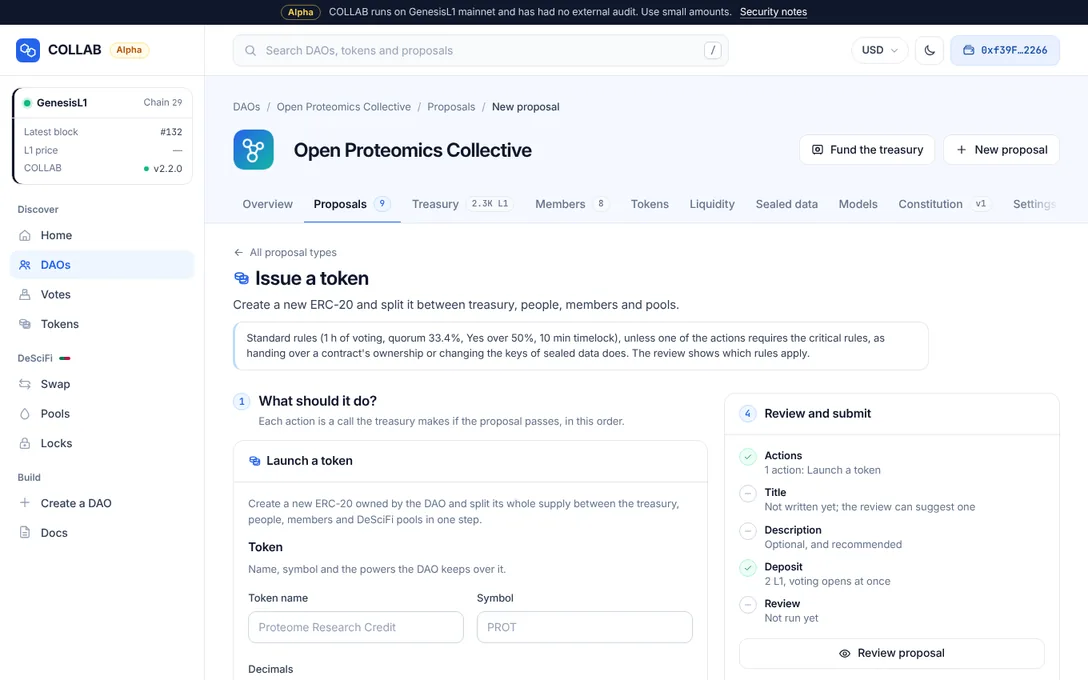
An Issue a token proposal has one action, Launch a token: "Create a new ERC-20 owned by the DAO and split its whole supply between the treasury, people, members and DeSciFi pools in one step." When the proposal executes, COLLAB's token launcher creates the token, gives its ownership to the treasury and hands out every token in the same transaction. If any part fails, nothing is created.
Where treasury spends are critical, a launch needs the critical rules, because it sets its own prices and allocations; see When treasury spends are critical. The Conservative preset makes Issue a token critical in any case.
The token itself
| Field | What it means |
|---|---|
| Token name | Up to 64 bytes of well-formed text. |
| Symbol | Up to 16 bytes; the form takes letters, digits, dot, dash and underscore. |
| Decimals | 0 to 18. 18 is the usual choice; every amount in the form is entered in whole tokens. |
| Mintable | The DAO can create more tokens later with a Manage a token proposal, never above the cap if there is one. |
| Burnable | Any holder can destroy their own tokens, for example to retire credits. The DAO can always burn tokens it holds. |
| Pausable | The DAO can stop transfers between holders in an emergency; the treasury can still send and receive. |
| Maximum supply (cap) | Optional. Minting can never take the supply above it. |
| Logo (optional) | PNG, SVG, WebP, JPEG, GIF or AVIF up to 64 KiB, stored on chain. Reviewing the proposal uploads it in one transaction from your wallet. |
Minting and pausing can be given up later; burning cannot, and no capability can be added after the launch. Leave all three off for a fixed supply with no admin powers beyond the logo.
The token's address is fixed in advance from the treasury's address and a random salt included in the proposal, so members can check pools and links before they vote. Use another address draws a new salt.
Splitting the supply
The launch creates the whole supply at once and must hand out every token: the parts must add up exactly to the Total supply, or the launch fails. A meter follows every allocation as you fill in the form.
- To the treasury: held by the DAO and spent only by proposal. Give the treasury everything not allocated fills in the rest.
- People: contributors, partners or funders who receive tokens directly at launch, up to 256 named recipients. Split an amount equally among these addresses takes a pasted list of addresses and an Amount to split.
- Member airdrop: tokens members claim themselves, equal per member or pro rata to shares, until Members can claim until; see Member airdrops.
- One-sided launch pools: only the new tokens go in; a virtual reserve of the token they are Priced in sets the Starting price. Buyers bring the other token, so the treasury spends nothing. Launch pools charge 0.30% or 1.00% per trade.
- Two-sided pools: the treasury pairs the new tokens with an asset it already holds, such as L1 or a stablecoin, and the two amounts set the opening price. Standard pools charge 0.10%, 0.30% or 1.00%, and there is one pool per pair and fee tier.
A launch can seed up to 8 pools in total. A two-sided pool is created by the launch itself: DeSciFi pools can only be created for token contracts that already exist, so nobody can block a launch by creating its pool in advance at the token's predicted address. The treasury approves the launcher for exactly the paired amounts just before the launch, and every approval is reset to zero right after it, in the same proposal.
LP tokens and their fees
Every pool a launch seeds gives LP tokens, and the form asks where they go:
- To the treasury: the DAO can later remove the liquidity or lock it by proposal, and collects its fees by proposal.
- Lock until a date or Lock forever: the LP tokens go into a lock box the treasury owns. A permanent lock is burned liquidity: it can never be withdrawn, and its fees keep flowing.
For a lock, Lock fees go to The treasury, The burn address (fees are destroyed) or Another address. The recipient is fixed when the lock is created; anyone can trigger the payout, and it always goes there. DeSciFi keeps swap fees apart from the liquidity, which is why locked or burned liquidity still earns; see Fees kept apart and LP locks.
What the review shows
Launch summary says exactly what the launch does if the proposal passes, and the review decodes every call. Nothing is summarised away: an allocation summary that must add up to the supply, then every recipient with its share, largest allocation first, and a warning when one account outside the treasury receives a quarter of the supply or more.
Anyone can use the token launcher, so who launched a token proves little by itself. COLLAB marks a token as issued by a DAO only when the launcher's own record names a DAO of this COLLAB factory, and it names that DAO by its permanent web address. That is information, not a recommendation: any account can create a DAO with another DAO's name and logo. See Verification.
Member airdrops
A DAO can share L1 or any token with its members: from the treasury, with the Member airdrop action of a Treasury spend proposal, or as part of a token launch.
Who qualifies. Accounts with voting shares in the block before the proposal that creates the airdrop was submitted, not when it executes, so nobody can buy into an airdrop once it has been proposed. The treasury, frozen members and excluded accounts hold no voting shares and get nothing. To keep a pool or other infrastructure out, exclude it before the airdrop proposal is submitted; see Excluding infrastructure.
How it is split.
- Pro rata to shares: each member may claim in proportion to their voting shares at that block. Available in every DAO.
- Equal per member: every member may claim the same amount, the total divided by the number of members. Only for DAOs whose shares have never been transferable: once shares could move, one holder could have split them across many accounts and claimed on each, even after transfers were switched off again. What cannot be split evenly returns to the treasury after the deadline.
Claiming.
- Claims stay open for at least a day after the proposal executes: an airdrop whose closing date is less than a day after the execution cannot be created, and the execution fails. The composer checks the closing date against the times the proposal can execute and says when it is too early.
- When your wallet can claim, the DAO's Treasury section shows "You can claim …" at the top, with a Claim … button that names the amount. Your share also appears under Member airdrops there, and in the Members section under You.
- Anyone can trigger a claim for a member who is a person, and the tokens always go to that member: the list Members who have not claimed yet has Claim for them. A member that is a contract, such as a pool or a multisig, must claim for itself.
- A member who is frozen when they claim cannot claim; their share stays in the airdrop.
- After the deadline, anyone can return what is left to the address chosen at creation, normally the treasury, with Return … to … or, when everything was claimed, Close the airdrop. The caller only pays gas.
Airdrops from other accounts. Anyone can create an airdrop for a DAO's members, also with a token that imitates a real one. The Treasury section lists those apart, under "airdrops from other accounts", marked "Not created by this DAO". Check such a token's address before you claim it, and never approve or trade it on a site you do not know.
Token administration
The treasury owns every token the DAO launched, so every change is a Manage a token proposal. Its actions:
| Action | What it does |
|---|---|
| Mint | Creates new tokens, never above the cap, for the treasury by default or for another address (Mint to). Minting dilutes every holder. |
| Pause transfers | Stops transfers between holders, trading in DeSciFi pools included. Transfers to and from the treasury still work, and minting and burning are never paused. |
| Unpause transfers | Lets holders transfer and trade the token again. |
| Give up a capability | Permanently removes minting or pausing. Giving up pausing ends a current pause at once. The burnable capability cannot be given up. |
| Change the logo | Replaces or removes the token's on-chain logo, up to 64 KiB. |
| Transfer ownership | Hands every admin power over the token to another address, usually another DAO's treasury, in one step. |
| Give up ownership | Leaves the token without an owner forever: no more minting, pausing or logo changes, and any pause ends. Only burning by holders remains, if the token is burnable. |
| Burn from the treasury | Destroys tokens the treasury holds, reducing the total supply. |
Giving up a capability or ownership cannot be undone by any later proposal; the composer asks you to confirm it and shows who gains what.
Token logos still live in COLLAB's text store, addressed by their hash, as in earlier releases; only the DAO's own logo and description moved into its profile in 2.2. Changing a token's logo uploads the new image when you review the proposal.
Critical or standard. Manage a token proposals use the standard rules unless the DAO made the type critical (the Conservative preset does). Where treasury spends are critical, these use the critical rules, because they can move treasury value: burning tokens the treasury holds, minting to anyone but the treasury, handing ownership to anyone but the treasury, and giving up minting or ownership. Giving up pausing does not.
The DAO's Tokens section
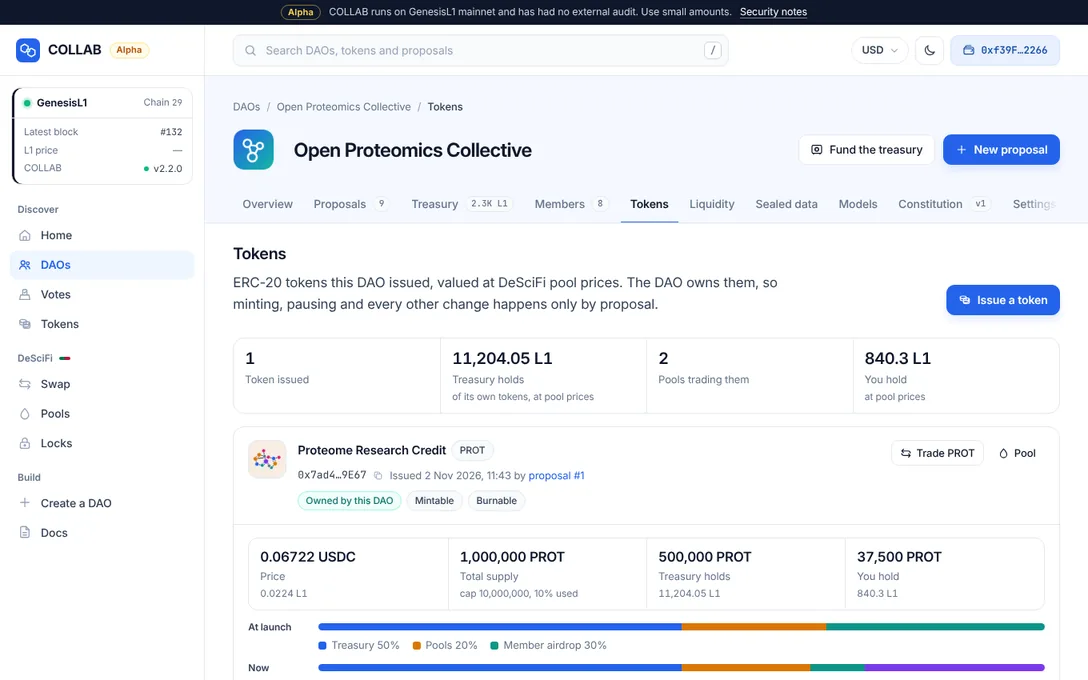
The Tokens section of a DAO, at /dao/<web address>/tokens, lists the ERC-20 tokens this DAO issued, valued at DeSciFi pool prices. Only tokens the treasury created through the COLLAB token launcher appear: the launcher records the DAO that called it, so nobody else can add a token here.
- A summary row counts the tokens issued, what the treasury holds of them, the pools that trade them and what you hold.
- Each token shows its Price, Total supply (with its cap, or "no cap", or "fixed supply"), Treasury holds and You hold, and when and by which proposal it was issued. Its header says who owns it (Owned by this DAO, another owner, or nobody) and which capabilities remain, or No admin powers.
- A figure shows where the supply sits, at launch and now: the treasury, DeSciFi pools, unclaimed airdrops and other holders.
- A table lists the DeSciFi pools that trade it, with their reserves, who holds the liquidity (the treasury, its locks, others) and Trade.
- Manage by proposal, at the foot of each token, opens each Manage a token action directly; giving up a capability and transferring or giving up ownership are folded under Ownership and capabilities.
- How token decisions work states which rules each kind of token proposal uses in this DAO.
With no token yet, the section offers Issue a token.